Introduction
With CF-MESH+ 5.5, we focused on a problem that has become increasingly important as CFD models have grown in complexity.
In the past, meshing often started from relatively clean and well-prepared geometry.
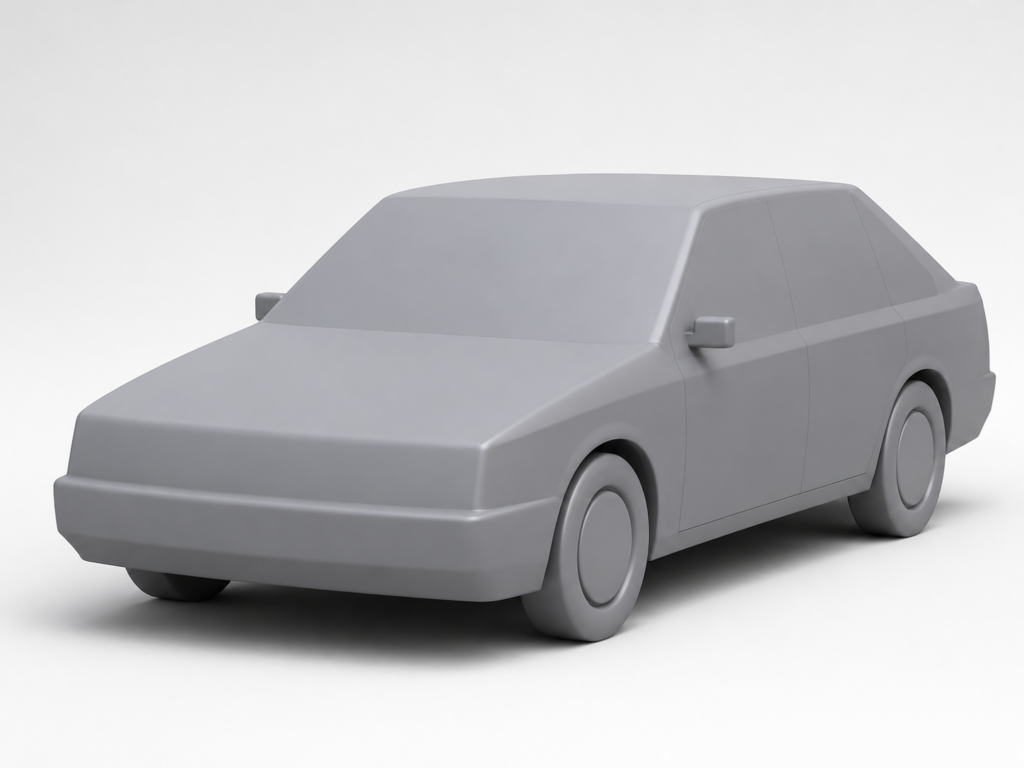
Today, CFD workflows increasingly rely on large CAD assemblies, tessellated surfaces, scanned data, and geometry that has passed through multiple pre-processing steps. As a result, triangulated surface meshes are more likely to contain missing triangles, noisy regions, false sharp edges, and broken connections that do not represent the real geometry.
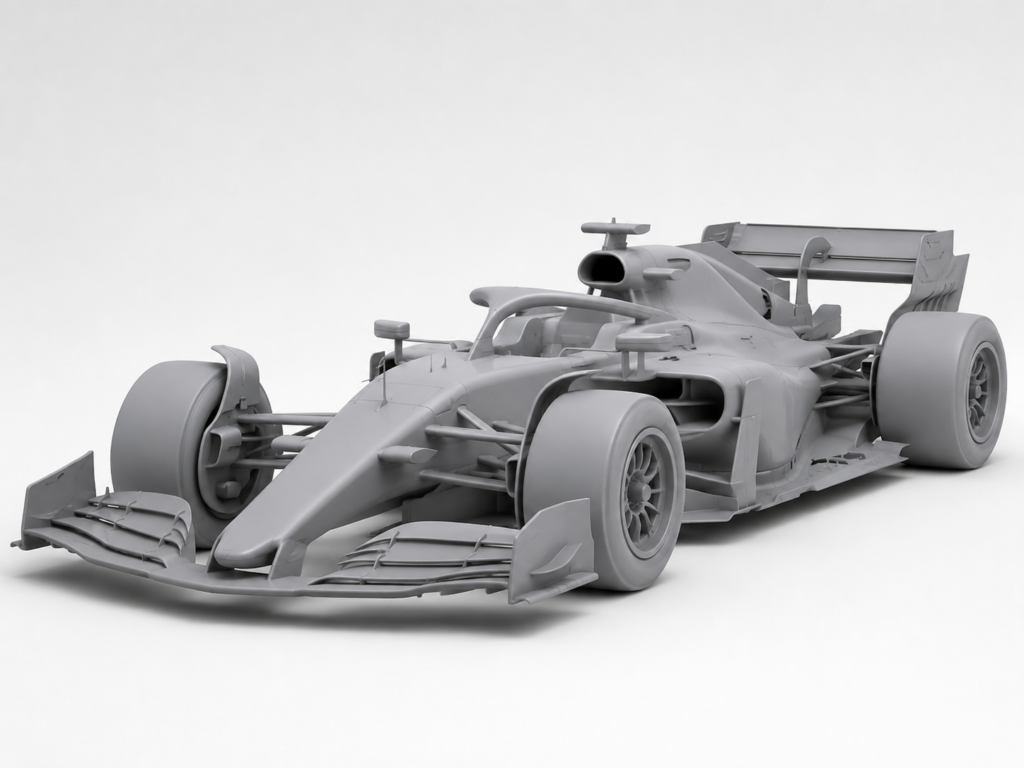
These defects are especially problematic during boundary-layer generation, where the local feature size can collapse toward zero or the surface can become difficult to interpret reliably, leading to poor-quality cells, unstable boundary layers, longer runtimes, or meshing failure.
CF-MESH+ 5.5 significantly improves how these situations are handled, making the mesher faster, more robust, and better able to maintain high mesh quality on complex and imperfect input.
What is new in 5.5.
Key additions include native SU2 mesh export, a new utility for converting face zones into patches, and a new surface reconstruction procedure with control over maximum dihedral angles to improve robustness and boundary-layer coverage.
CF-MESH+ 5.5 introduces several improvements focused on robustness, mesh quality, and performance.
The release also improves invalid-topology detection and non-manifold inspection, while enhanced vectorisation significantly speeds up the most time-consuming mesh optimisation algorithms.
On the GUI side, clipping and visibility controls for surface and volume meshes have also been improved.
5.4. vs 5.5. on Broken Triangulated Geometry
To demonstrate the impact of these improvements, we compared CF-MESH+ 5.4 and 5.5 on a deliberately broken example: a broken triangulated surface mesh containing missing triangles, artificial sharp edges, and general surface noise.
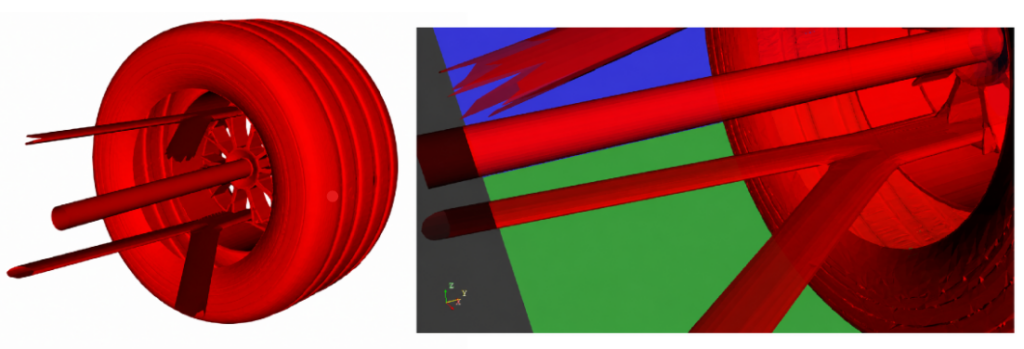
This type of input is becoming increasingly common as CFD cases grow in complexity. Surface meshes often come from tessellated CAD exports, scanned data, reconstruction workflows, or models that have already passed through several processing steps. As a result, the final triangulated surface may include defects that are not physically meaningful, but still have a major influence on the meshing process.
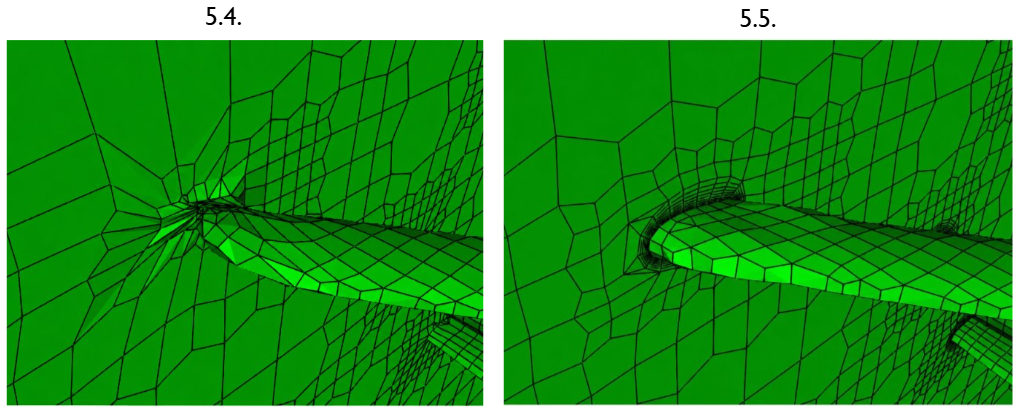
In CF-MESH+ 5.4, these problematic regions could force the mesher to respond too literally to the surface description. Artificial sharp features and damaged triangulation could drive excessive local refinement and make boundary-layer generation more difficult. That often increased meshing cost and reduced mesh quality exactly in the regions where robustness mattered most.
In CF-MESH+ 5.5, the mesher handles these cases much more intelligently.
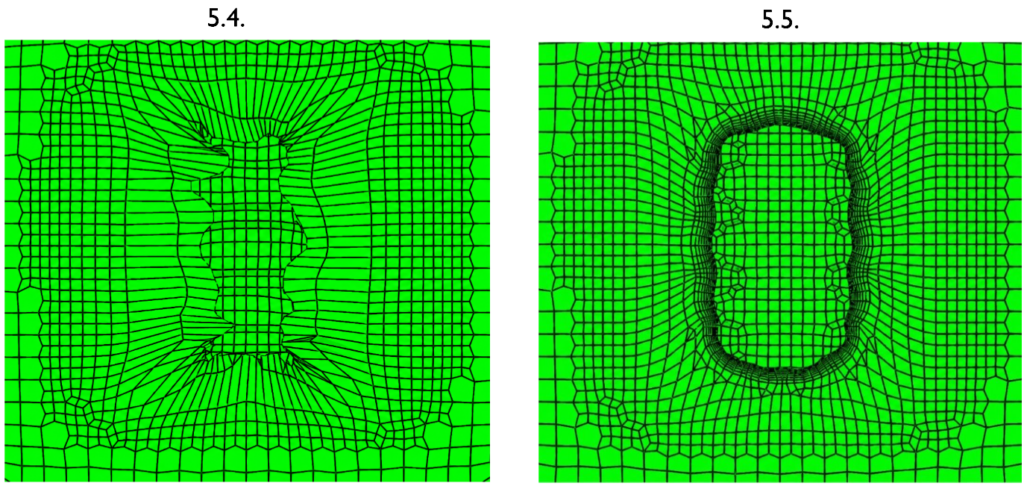
The updated surface projection and edge extraction procedure gives users direct control over how sharp local features are treated through the maxDihedralAngle setting under Surface Optimisation. This allows the surface to adapt problematic angles and local feature sizes to the cell size specified in that region.
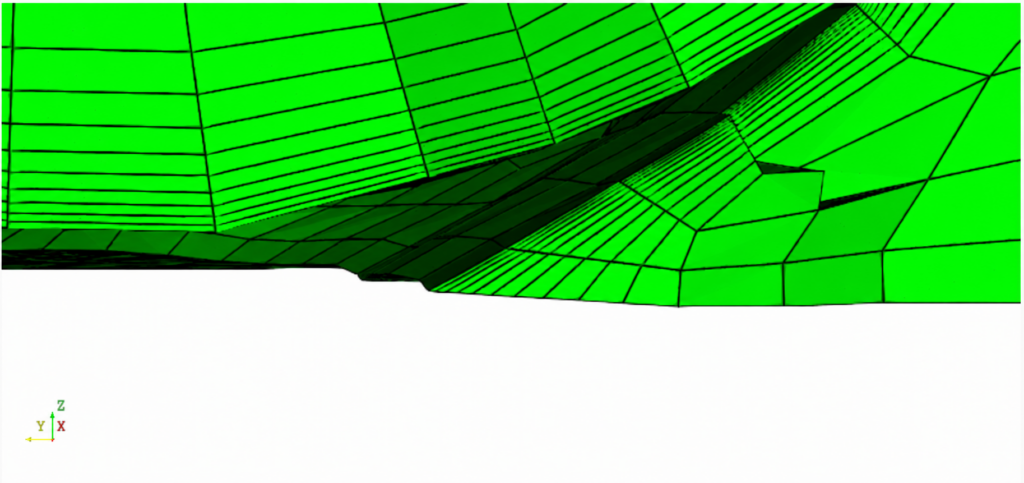
A typical example is a wheel positioned directly on the ground. Near the contact point, the local feature size tends toward zero and there is effectively not enough space for a mesh cell to fit between the two surfaces. The new algorithm automatically detects such regions and treats them appropriately instead of attempting to resolve an increasingly small feature.
In practice, a maxDihedralAngle of around 150° is a good rule of thumb and typically produces high-quality mesh topology while preserving the relevant geometric features.
As a result, the mesher no longer overreacts to false sharp edges, missing triangles, or local surface noise. Instead, it adapts automatically in those problematic areas, producing a better-quality mesh with less unnecessary refinement.
Why It Matters for Real CFD Workflows
As CFD models continue to increase in scale and complexity, imperfect surface input is becoming the norm rather than the exception. Users need a mesher that can work reliably with noisy triangulation, incomplete surfaces, and artifacts introduced by geometry conversion or preprocessing.
That is exactly where CF-MESH+ 5.5 delivers a clear improvement over 5.4.
Instead of forcing users to spend significant time cleaning and repairing geometry before meshing, the new version handles many of these issues automatically. It recognizes problematic regions more accurately, avoids over-resolving artificial defects, and produces higher-quality meshes in less time.
Once the surface topology is well resolved and of high quality, the mesher can easily generate high-quality boundary layers.
I hope that you have found this post useful and that it has made you curious to try out CF-MESH+ . You can also subscribe to our newsletter to stay informed on our newest developments.